For Greater Manchester to meet its carbon emissions target by 2038 we need to start making the transition on how we heat our homes and buildings from gas to electricity. Heating homes accounts for one third of our carbon emissions and the majority of homes in Greater Manchester are heated by gas. A greener solution is to use electricity. Electricity has lower carbon emissions, as more and more sources of renewable energy are being used to generate the electricity we use.
Heat pumps are usually the most efficient way to generate heat from electricity; they have an important role to play in the transition to net zero, particularly in the residential homes. Whilst not traditionally common in the UK, they are widespread in other countries, including keeping homes warm across Northern Europe. With new builds, it may be worth considering the option of ground source heat pumps, at a new build stage this can be a cost-effective option as it can be worked into the build costs.
Awareness of heat pumps has increased steadily over recent years, a central government survey showed that 76% of people were aware of air source heat pumps in Summer 2025. Despite this, there remains some uncertainty with the technology, with around 1 in 5 reporting that they didn’t know enough about heat pumps to invest.
This lack of knowledge has contributed to common myths about Air Source Heat Pumps which have undergone significant improvements over recent years, here are some of the more common myths:
TOP 10 MYTH BUSTING FACTS
- Myth 1: “Can Heat Pumps only be installed in new build?”
No. Heat pumps can be installed into any property type and can be fitted into older buildings that are traditionally considered harder to heat.
Heat Pump Installers will consider the property, its occupants and lifestyles, to find the right heat pump system for you. Considering other factors may help you get the desired end result of an effective, efficient and low carbon heating system. These can include insulation upgrades, changes to radiators and pipework, the positioning of the heat pump outside your property, hot water cylinder or a particular type of heat pump set-up.
- Myth 2: “Are Heat Pumps only to be used for heating rooms and not water?”
The most common type of heat pump in the UK is an air-to-water heat pump. They absorb heat from the outside air and transfer this heat to water. The system distributes heat via a wet central heating system so providing heat to radiators, or underfloor heating, as well as to a cylinder for hot water.
Heat pumps are more efficient when the radiator temperatures are lower. The radiators or underfloor will be correctly sized and designed so that you will be warm and comfortable even in winter.
- Myth 3: “Do you need underfloor heating for air source heat pumps to work?”
No. While Underfloor heating can be a more efficient way to heat a house or building, radiators can be extremely efficient in giving out heat over a long period at lower temperature settings provided that they are correctly sized.
- Myth 4: “Do Air Source Heat Pumps only work when its warm outside?”
No. Like any heating system when it is cold, air source heat pumps will need to work harder to keep a house warm. How much energy they use depends on a number of factors, including how well insulated your home is. Air source heat pumps can still effectively extract heat from the air and keep your house warm even when temperatures drop to around -25°C, while some advanced cold-climate heat pumps work in temperatures as low as -35°C.
- Myth 5: “Do Heat pumps require more maintenance than boilers?”
No. Heat pumps require a similar level of maintenance as gas boilers. Many heat pump manufacturers provide a seven-year warranty if the unit is serviced regularly. Similar to boilers, heat pumps should be serviced annually to ensure they are working efficiently and to extend the system’s lifetime. According to the Energy Saving Trust, a well-maintained and well-operated heat pump can function for 15-20 years or more. Ground-source heat pumps should last longer because they are not exposed to the elements. This compares favourably with the lifecycle for gas boilers at 8-12 years and contributes to reducing the total cost of ownership.
- Myth 6: “Is planning permission required for all heat pump installs?”
No. Installation of a single heat pump at a domestic property such as a house, or a block of flats is usually classed as permitted development (as long as certain conditions are met) and so does not require planning permission. There are some exceptions to this e.g. if the land is in a conservation area (The Town and Country Planning (General Permitted Development) (England) Order 2015 (legislation.gov.uk). Planning Permission is required for non-domestic installations.
- Myth 7: “Are Heat Pumps big and ugly?”
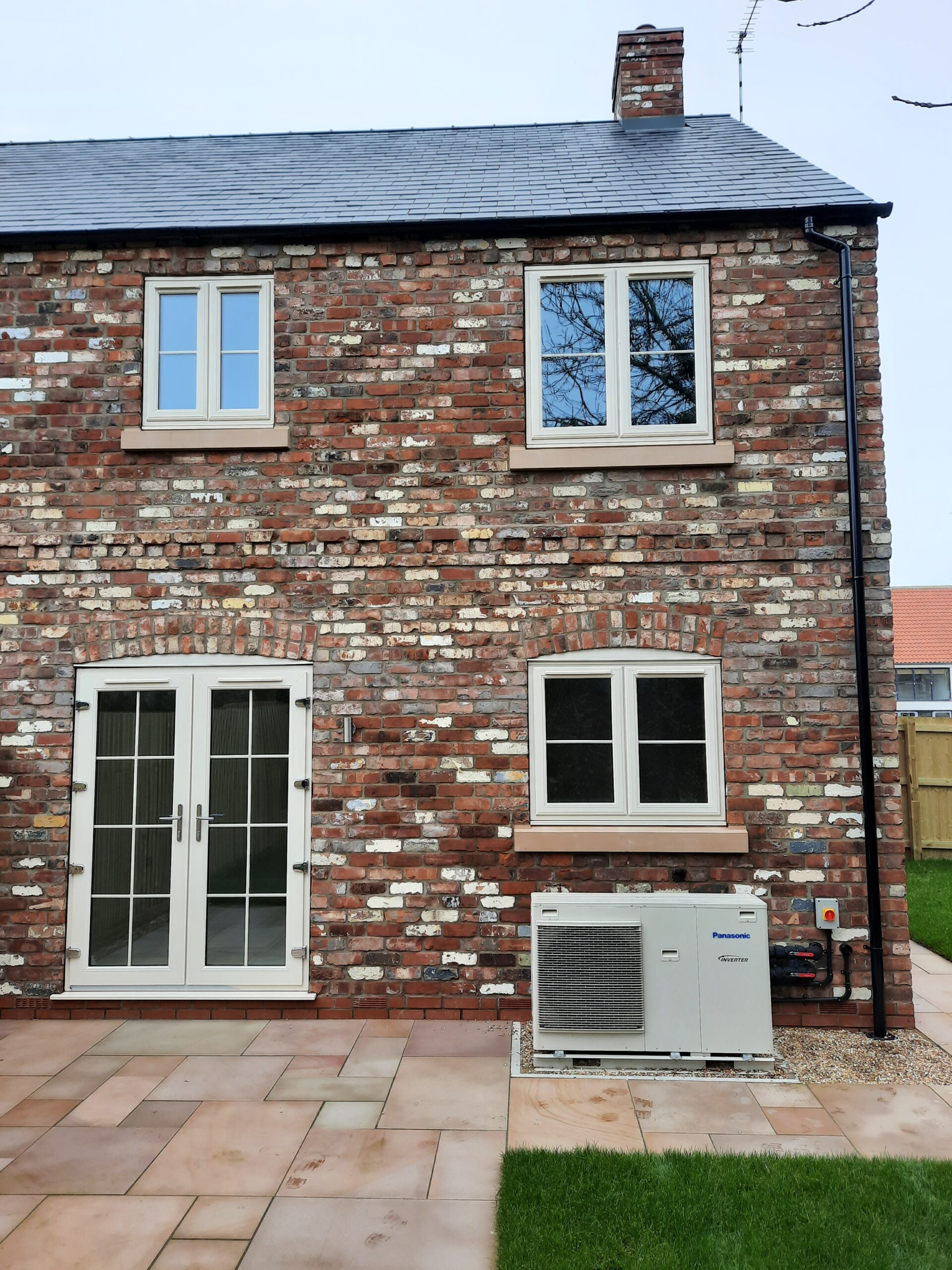
No ugly ducklings here. The largest part of an air source heat pump system is normally installed outside the property, so it will not take up much space inside. The external units of air source heat pumps are a similar size to the external unit of conventional air conditioning systems, commonly seen outside offices. The units can be coloured or camouflaged with different types of cover (provided that air flow is maintained) to match the exterior of a property. Inside the house, the unit’s heat distribution system is not much different from the one used in gas or oil heating systems.
The external unit requires some space around it to obtain a good flow of air. “Split” systems are connected to an internal unit which is often smaller than an average boiler. A heat pump usually requires a hot water cylinder but if there is not enough space for one, a heat battery can be considered instead (it does the same job as a hot water cylinder, but can be up to 75% smaller).
- Myth 8: “Do you need a well-insulated house to install a heat pump?”
No. A heat pump can be installed in any property. However, to make it affordable to keep your home warm you will need a certain level of insulation. The better the insulation the smaller the heat pump you will need to heat your home and the lower your energy bills will be. The Feel the Benefit portal can help you assess if you can access financial support to help with installation costs.
- Myth 9: “Are Heat Pumps expensive to install and run?”
Air source heat pump systems are not much more expensive to install than a fossil fuel system, but will cost more than replacing a boiler. According to the Heat Pump Federation, a fully commissioned air source heat pump system can cost between £6,000 to £10,000*. There may be additional expenditure to upgrade the existing heating system if some of the radiators are too small. If your heating distribution system i.e. the radiators, pipework, underfloor heating etc., have been properly sized for a condensing boiler to operate in condensing mode, then it is likely that no upgrades will be required.
The price of air source heat pump systems are falling and with the government’s Boiler Upgrade Scheme, you can get a grant for up to £7,500 to replace a fossil fuel boiler with a heat pump.. Going ‘all electric’ will also remove the standing charge for gas. This saving can be around £120 a year*. Check your local council website for any financial incentives that may be available to help you towards the cost of installation.
Similar to any form of heating the cost of running an air source heat pump system will be dependent upon usage, how well insulated your home is and how warm you want it to be. The biggest potential for operating cost increases comes from how heat pumps are used by the individual rather than the technology itself. If used incorrectly they can be costly.
An air source heat pump, is 3 to 4 times more efficient than a gas boiler, potentially saving you money on heating bills as they give out a lot more heat than the electricity they use to run. While the Government is committed to moving energy taxes from electricity to gas, currently electricity is more expensive than gas. The higher heat pump efficiency means that the running costs often work out similar, and if an old and inefficient fossil fuel system is being replaced, bills could potentially reduce greatly.
The Energy Saving Trust estimate that replacing an old (G-rated) gas boiler with an air source heat pump, could save a resident up to £260 a year on their heating bills (based on a three bedroom semi-detached home with radiator upgrades as needed).
Currently in the UK, a zero rate of VAT applies to the groundworks necessary for the installation of ground and water source heat pumps in domestic accommodation. From 1 April 2027 onwards these will revert to the reduced VAT rate of 5%.
*Please note these figures are only estimations.
- Myth 10: “Are Air Source Heat Pumps loud?”
No. The technology has advanced considerably, and modern heat pumps are quieter than when they first came to market and if installed correctly they are no louder than a fridge or a traditional boiler flue.
What is an air source heat pump and how do they work?
Air source heat pumps are a proven technology allowing you to generate your own renewable heat. They are a low carbon way of heating your home, potentially saving you money on your fuel bills, especially if you’re replacing electric storage heaters, oil, liquefied petroleum gas (LPG), or coal.
They work by absorbing heat from outside and then use it to increase the temperature inside your home. The main unit is normally situated outside your house. Air source heat pumps look similar to air-conditioning units found outside many shops. Like a gas boiler, their sizes vary and are dependent upon how much heat is needed to be generated for your home, the bigger and warmer you want your house, the bigger the heat pump.
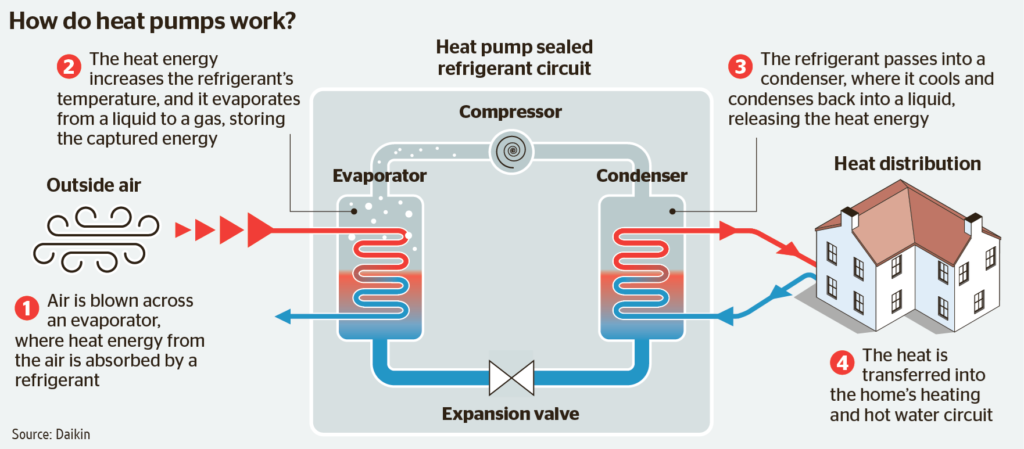
They work similar to refrigerators but in reverse. They take heat from the air outside and bring it into your home for heating and hot water. Heat is absorbed from the outside air by a liquid refrigerant at a very low temperature, as the liquid warms it turns into a gas, storing the energy it has taken from the air. Electricity is then used to compress the gas back into a liquid inside your house, in doing so the stored energy is released into your heating system. This heat is stored in hot water and is then pumped around your home to your radiators or underfloor heating, and your hot water cylinder like a traditional central heating system.
Heat pumps harvest ‘free’ heat from the ambient air outside a building using some electricity. They can produce 2.5 to 4 times more heat energy than the electrical energy they consume, making it an energy efficient way to heat your home. When correctly specified and installed, they work well even when outside temperatures are considerably below zero, as is the case in Scandinavia, where the technology is in routine use.
Sources: Air Source Heat Pumps Explained – Which?, Heat Pump Federation.
Photo credits: Panasonic
Resources
Related Content

More than 1,000 people to learn retrofitting skills to help city-region achieve net zero future

Retrofitting Task Force to drive forward plans for low-carbon homes across Greater Manchester

Greater Manchester plans to deliver a smarter local energy system as it leads on Net Zero challenge