In our latest Greater Manchester Green Summit guest blog, earth4Earth discuss creating carbon-negative bricks that capture and store CO₂, turning buildings into long-term carbon sinks.
What if building materials could remove carbon instead of producing it?
earth4Earth has developed carbon-negative bricks that transform walls into long-term carbon sinks, while maintaining the performance and simplicity of traditional masonry.
Traditional fired clay bricks require high-temperature kilns, and many stabilising binders are produced via energy-intensive routes. At earth4Earth, our focus is simple: keep what works about bricks (durability, ease of installation, proven performance) and re-engineer what doesn’t (embodied carbon and waste).
Our approach starts with the feedstock. Instead of virgin clay, we upcycle excavated soil, a by-product of construction that too often ends up in landfill and convert it into a consistent brickmaking raw material. The bricks are compressed rather than fired, avoiding the kiln stage that dominates emissions in conventional brick manufacture.
The real innovation comes from our patented DCUS technology: a full life-cycle route to net zero that integrates Decarbonisation, carbon Capture, carbon Usage and carbon Storage. Our patented technology captures and permanently stores carbon throughout the brick’s lifecycle.
Throughout their lifecycle, the bricks remove CO₂ directly from ambient air via carbonation, a spontaneous reaction where lime-based compounds react with atmospheric CO₂ (in the presence of moisture) to form stable carbonates. For our N10 brick (10% binder), this equates to 178 g CO₂ captured per brick during service life, with a certified net life-cycle CO₂ balance of −0.013 kg CO₂ and a public EPD3.
Crucially, this is already happening in the real world. In Manchester, our first UK pilot project, the “Wonderwall”, used 1,200 N10 bricks to create a 4 m × 4 m internal feature wall at Sustainable Ventures (Sister Renold Building), demonstrating how interior architecture can function as a long-term carbon sink. In China, our bricks have been deployed at scale in a water treatment project (200,000 bricks), with whole-life accounting that projects 36.5 tonnes of CO₂ removal over 20 years and a net verified removal of 16.4 tonnes after embodied emissions and transport.
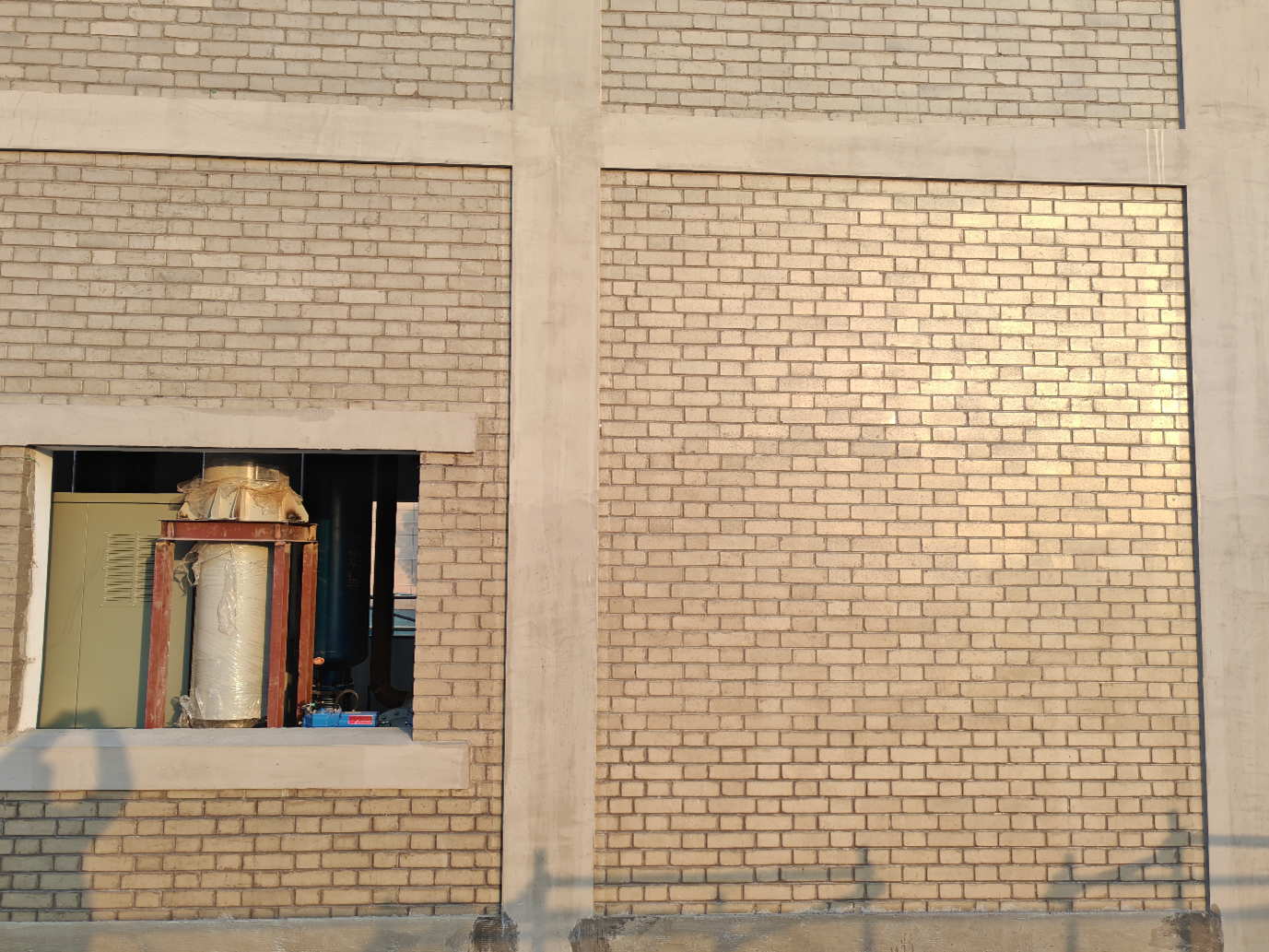
The bricks can be installed using standard construction methods without specialist training.
References
(1) Brownell, B. How Can We Reduce the Carbon Footprint of Bricks? architectmagazine.com. August 17, 2023.
(2) Hanein, T.; Simoni, M.; Woo, C. L.; Provis, J. L.; Kinoshita, H. Decarbonisation of Calcium Carbonate at Atmospheric Temperatures and Pressures, with Simultaneous CO2capture, through Production of Sodium Carbonate. Energy Environ. Sci. 2021, 14 (12), 6595–6604. https://doi.org/10.1039/d1ee02637b.
(3) earth4Earth. Environmental Product Declarations. https://earth4earth.co.uk/epds.